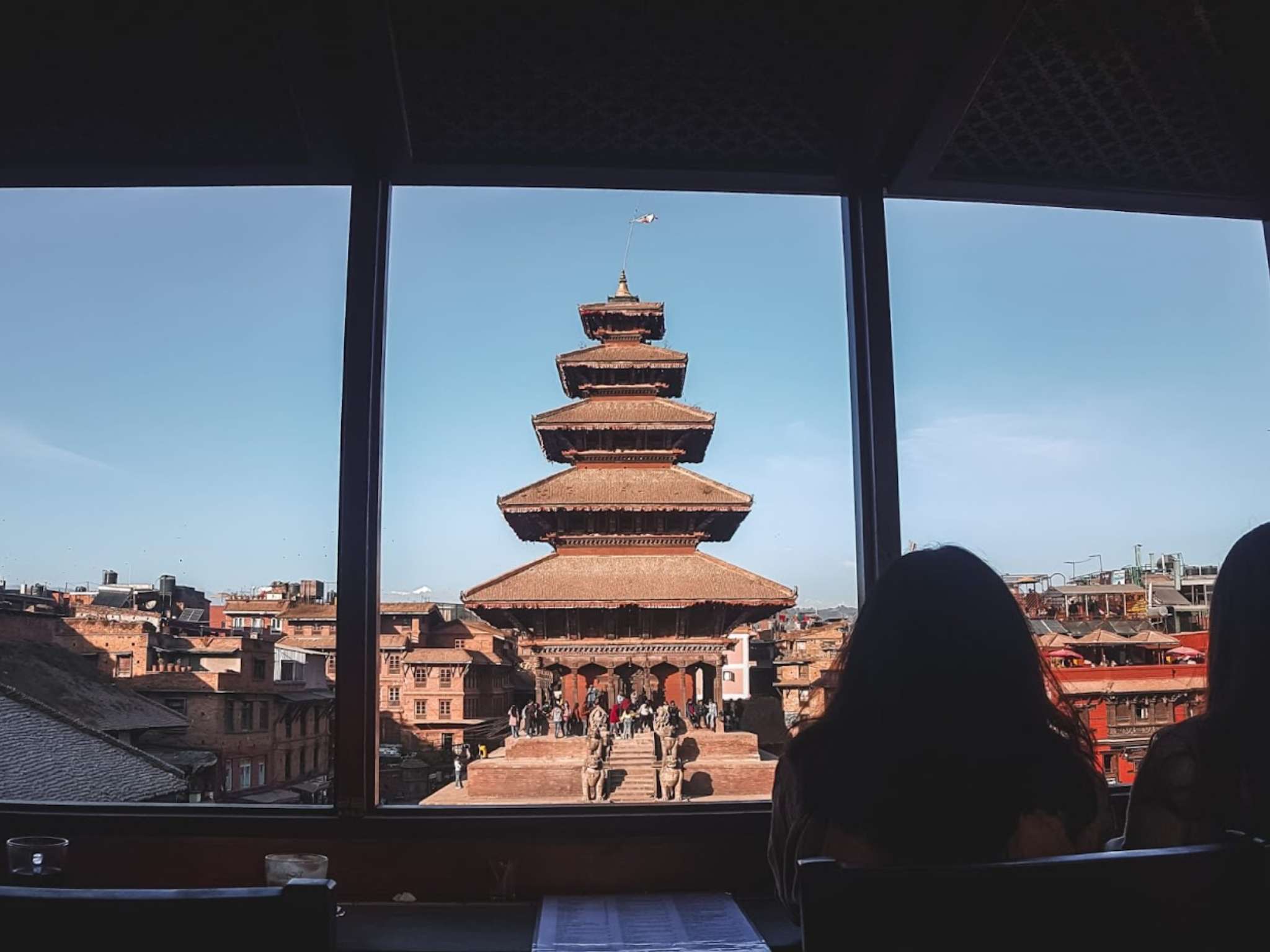
What is Bhaktapur Durbar Square?
Bhaktapur Durbar Square is the former royal palace square of Bhaktapur, an old city also called Bhadgaon. The Nepal Tourism Board says its buildings date from the 13th to the 18th centuries. It’s one of the seven monument zones of the Kathmandu Valley World Heritage property, inscribed in 1979.
The board calls Bhaktapur the “City of Devotees”. It describes brick-paved roads, red brick houses and a tradition of pottery and woodcarving.
Where is it, and how far is it from Thamel?
Bhaktapur lies east of Kathmandu on the Arniko Highway, at 1,401 m above sea level. Sources disagree on the distance. The Nepal Tourism Board says 12 km from Kathmandu, while bhaktapur.com says about 20 km. By our own map measurement, it’s 12.5 km in a straight line from Thamel, and the road is longer.

Who built Bhaktapur Durbar Square?
The Malla kings built the square, and earthquakes have reshaped it several times since. Bhaktapur was the Malla seat here until the Gorkha conquest of 1769.
| Date | What happened |
|---|---|
| 14th to 15th centuries | Malla kings use the palace, and building of the square begins |
| 15th century | Yaksha Malla commissions copies of the Char Dham pilgrimage temples |
| 1484 | Queen Karpura Devi consecrates the Yakshasvara Temple in memory of her husband, Yaksha Malla |
| 1672 to 1696 | Reign of Jitamitra Malla, who consecrates two Vatsala temples in 1695 |
| 1681 | An earthquake damages the palace |
| 1696 to 1722 | Reign of Bhupatindra Malla, who completes the 55 Window Palace in 1698 or 1708, according to Wikipedia |
| 1701 to 1702 | Nyatapola Temple is built |
| 1737 | Ranajit Malla, the last king, offers the Taleju Bell |
| 1769 | The Gorkhalis conquer Bhaktapur, and the square falls into disrepair |
| 1833 and 1934 | Two more earthquakes cause major damage. The 1934 quake reduces the square to its present size |
| 1979 | UNESCO World Heritage listing |
Wikipedia gives both 1698 and 1708 for the 55 Window Palace, and the Nepal Tourism Board calls it 15th-century. The Golden Gate has two dates as well: Wikipedia says 1751 to 1754, and Wikivoyage says 1756.
What is there to see in the square?
The square has the palace on one side and a crowd of temples around it. Here are the named sights, grouped by area.
The palace
- Palace of 55 Windows (Pachpanna Jhyale Durbar): Named for its carved windows. The 1934 earthquake destroyed its top floor. Its murals include a Vishvarupa scene that some historians rate highly.
- Golden Gate (Lun Dhwakha): A gilded entrance to the Taleju shrine, and the last major work of the Malla period, according to bhaktapur.com. The Nepal Tourism Board calls it a repoussé masterpiece.
- Lion Gate: Damaged in the 2015 earthquake. The Nepal Tourism Board lists it among the square’s landmarks.
- Statue of King Bhupatindra Malla: On a stone pillar, facing the Taleju Temple.
- National Art Museum: In the old Simhadhwoka palace, guarded by Hanumanta Bhairav and Narasimha statues. It holds Malla and Licchavi sculpture, manuscripts and paintings.
- Taleju Temple in Mul Chowk: The holiest shrine here, closed to non-Hindus. The Taleju Bell rings daily during its worship.
- Lunhiti Chowk (Sundhara): A golden water spout built under King Jitamitra Malla.
Temples in the square
- Vatsala Durga Temple: A stone temple in the shikhara style (a tall tapering tower). It’s dated 1672 by The Longest Way Home, and Wikipedia puts a Vatsala consecration in 1695.
- Taleju Bell and the “barking bell”: Sources mix these up. The Nepal Tourism Board says Ranajit Malla set up the “Bell of Barking Dogs” in 1737. The Longest Way Home and bhaktapur.com say the 1737 bell is the Taleju Bell, and that the barking bell is a smaller one from Bhupatindra Malla in 1721.
- Yakshyeshwor (Pashupatinath of Bhaktapur): Built in memory of Yaksha Malla, and still used for worship. It’s called “Pashupati of Bhaktapur” because it looks like the temple in Kathmandu.
- Fasidega (Silu Mahadev): A Shiva temple on the east side of the 55 Window Palace, destroyed in 2015.
- Char Dham temples: Badrinath, Jagannath, Rameshwor and Dwarikanath. Wikipedia says Yaksha Malla commissioned them in the 15th century. A priest quoted by bhaktapur.com credits Bhupatindra Malla.
- Kedarnath Temple: A 17th-century terracotta temple.
- Chyasilin Mandap: Rebuilt in 1987 using steel beams. Its designers said it wouldn’t have survived 2015 without them. Local officials and conservationists criticised the work.
- Ugrachandi and Ugra Bhairav statues: Set up by Bhupatindra Malla at Basantapur Chowk.
Taumadhi Square, one minute away
- Nyatapola Temple: The five-storey temple to Siddhi Lakshmi, a Tantric goddess. Bhupatindra Malla built it from December 1701 to July 1702. It’s about 33 m tall, and five plinths on the stairs each carry a pair of stone guardians. Nobody but its priests goes inside.
- Bhairavnath Temple: A three-storey temple to Bhairav next to Nyatapola. Only Bhairav’s head lies in the inner room, according to the Nepal Tourism Board. Wikivoyage says the 1934 quake razed it and that it was renovated in 1995.
Dattatraya Square, 10 minutes away
- Dattatraya Temple: One of the city’s oldest temples. Bhaktapur.com gives both the 14th century and 1470, and credits King Yaksha Malla. Only Hindus may enter.
- Peacock Window: A 15th-century woodcarving in the Pujari Math building.
- Woodcarving Museum and Brass and Bronze Museum: Next to each other, and one ticket covers both, according to bhaktapur.com.

What did the 2015 earthquake do to Bhaktapur?
The 25 April 2015 earthquake hit Bhaktapur hard. Wikipedia reports that 116 monuments were damaged here.
Much of the rebuilding here has been run locally. In April 2019, The Kathmandu Post counted 9 of 21 damaged monuments restored, including Shankar Narayan, Bhimsen and Kedarnath. We found no complete list after that date.
- Fasidega: A foundation stone was laid in April 2016. Wikipedia’s caption shows it restored by 2022, in its pre-1934 form.
- Vatsala Durga Temple: Destroyed in 2015. Rebuilt from 2017 to 2021, according to The Longest Way Home.
- Bhairavnath Temple: Rebuilt with locally raised funds by 2019.
- Lion Gate: The municipality planned to rebuild it with its own funds as of 2019. We couldn’t confirm the current state.
- Thanthu Durbar: The wing that housed the municipal office was badly damaged, and it’s being restored to its Malla-era look, according to Wikipedia.
- Yaksheshwor Temple: The Auditor General found old timber wasn’t properly recorded or kept during rebuilding, The Rising Nepal reported in August 2026.
- Nyatapola: Stood through the quake, as it did in 1934, but its top floors tilted and needed repair.
Nationally, the Department of Archaeology says 825 of 920 damaged monuments had been rebuilt by August 2026.
How long do you need?
Allow half a day if you want the square, Taumadhi and Dattatraya. This is our estimate. One published seven-site tour gives Bhaktapur 90 minutes, which covers little beyond the square itself.

What is a good walking route?
This route follows the three squares in order.
- Enter from the west and walk to Durbar Square. Outdoor Nagarkot reports the main ticket booth at the western gate.
- See the Lion Gate, the Bhupatindra Malla statue and the Golden Gate.
- Walk along the 55 Window Palace, then stop at the Vatsala Durga Temple and the Taleju Bell.
- See Yakshyeshwor and Fasidega.
- Walk a minute to Taumadhi Square for Nyatapola and Bhairavnath.
- Continue about 10 minutes to Dattatraya Square for the temple and the Peacock Window.
For the shorter version, stop after Taumadhi.
What is the best time of day to visit?
Morning is the time bhaktapur.com recommends for temples and worship. It reports daily worship at Jagannath around 7 am to 8 am. Outdoor Nagarkot reports monument hours of 7 am to 6 pm, and we couldn’t confirm that officially.
If you come from a Nagarkot sunrise, you’d reach the city in the morning anyway. Compare our Bhaktapur and Nagarkot day tour.

What are the rules for dress and photography?
Dress modestly and take off your shoes before entering a temple. Bhaktapur.com says shoes come off at the Dattatraya Temple, and that only Hindus may enter there and at the Taleju Temple. For general advice, see what to wear in Kathmandu.
We found no published photo rule for the square. Ask before you photograph people at worship.
Are there steps, and is it accessible?
One report says the square offers access for wheelchair users. That comes from an Onlinekhabar article of November 2025 by a tour operator, with no detail on surfaces or ramps. The Nepal Tourism Board describes the city’s roads as brick-paved, so expect an uneven surface.
Bhaktapur.com counts 33 steps on the Nyatapola stairs. Wikivoyage says rickshaws, tuk-tuks and taxis aren’t allowed inside the old city, so you’ll cover the distance on foot. See our steps and mobility guide.

Which festivals happen here?
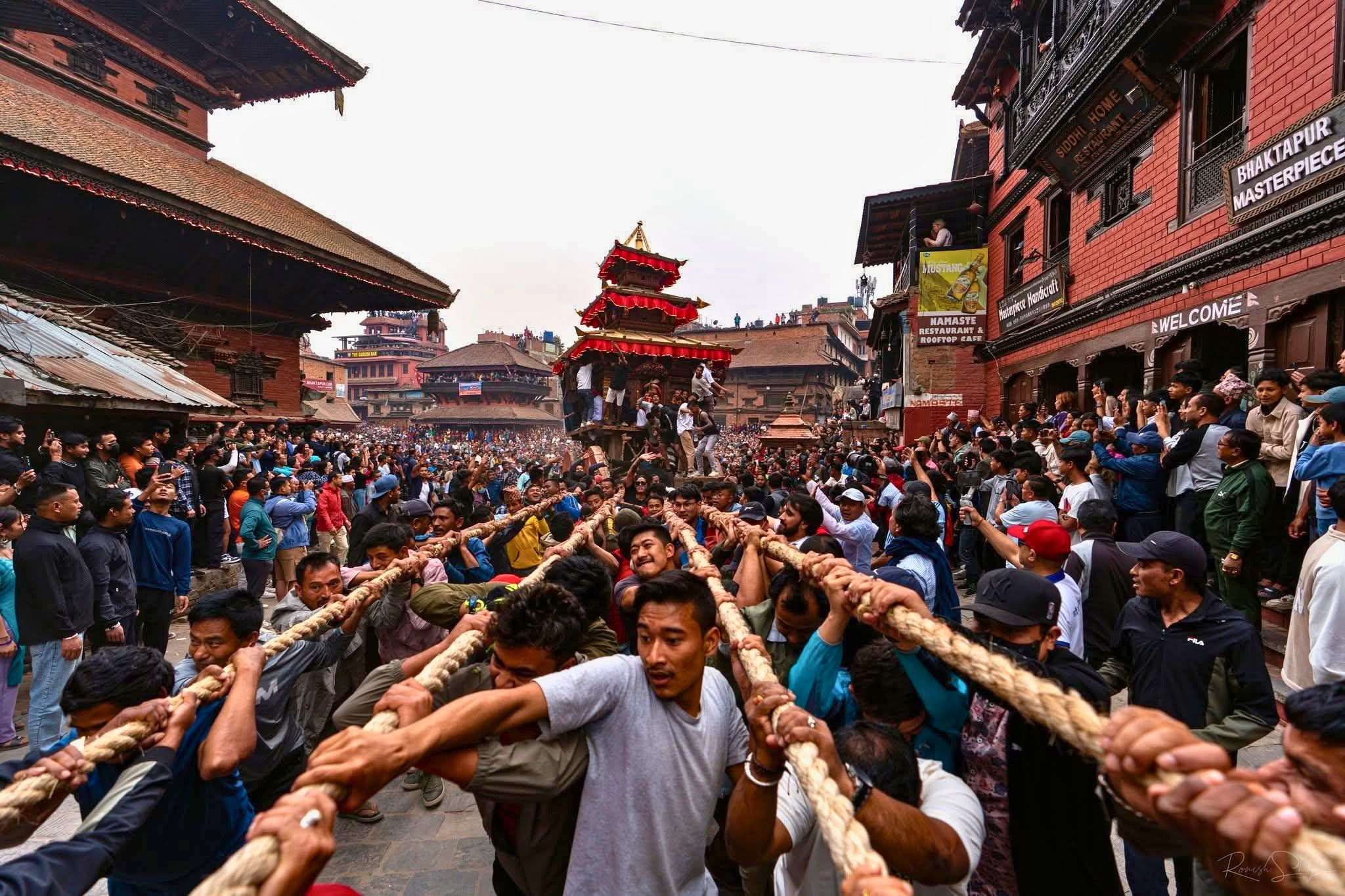
Bisket Jatra is the big festival. It marks the Nepali New Year in mid-April, and a tall pole called the Yosin goes up toward the end of the old year. Chariots carry the deities Bhairab and Bhadrakali through the city, while the upper and lower parts of town compete in a tug-of-war.
In 2026 it ran from 10 to 18 April. For the coming date, see our Bisket Jatra guide.
How do you get there?
A taxi or private vehicle is the simplest way from Kathmandu. Wikivoyage lists buses as well, taking about 40 to 60 minutes.
- Minibus: From near Bhadrakali in Kathmandu to the Kamal Binayak stop.
- Big bus: To the Charansingh stop.
- Express bus: From Bag Bazar, stopping only at Maitighar and Sallaghari.
- Taxi: See our Kathmandu taxi fare guide.
Pay on the bus when you get off, and agree the fare first. Wikivoyage warns that foreigners may be charged more.

What is near the square?
Changu Narayan is the closest of the other UNESCO sites, about 5 km north in a straight line. Our Changu Narayan guide has the details.
- Siddha Pokhari: A large rectangular pond from the Licchavi period, at the bus stop.
- Surya Binayak: A Ganesh temple, a 20-minute walk from the bus stop.
- Thimi: A Newar pottery town about 8 km east of Kathmandu, on the road to Bhaktapur.
How do you visit with a guide or alone?
You can visit alone with no booking. Buy your ticket at the gate in Nepali rupees, and carry it until you leave. The fee is the highest of the seven sites, so check the board before you pay.
A guide helps you sort out the conflicting dates and the three squares, and can check what’s open. Read do you need a tour guide in Nepal if you’re undecided.
Four tours on this page include the square. Our Bhaktapur day tour gives the city the most time, and adds Changu Narayan.