
What is Namo Buddha monastery?
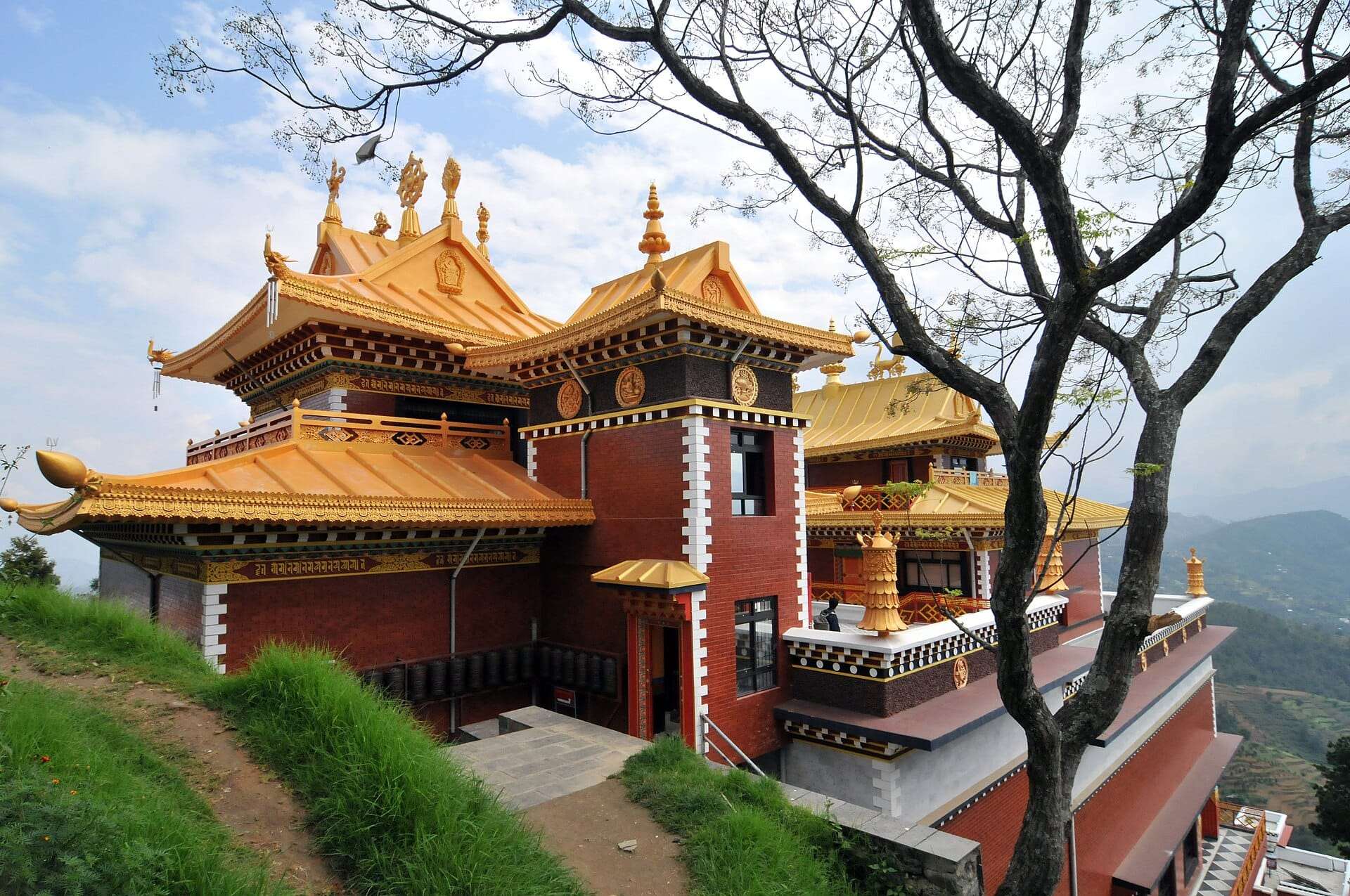
Namo Buddha monastery is the usual name for Thrangu Tashi Yangtse, a Tibetan Buddhist monastery on a hilltop in Kavrepalanchok district, south-east of the Kathmandu Valley. It belongs to the Karma Kagyu tradition, according to Wikipedia. Its gold roofs sit above the far older Namo Buddha stupa.
The two are often mixed up, because the place, the stupa, the monastery and the municipality all share the name. Here’s how they fit together:
| Name | What it is |
|---|---|
| Namo Buddha stupa | The old stupa linked to the tigress legend, on the slope below the monastery |
| Thrangu Tashi Yangtse Monastery | The large monastery on the hilltop, also called Namo Buddha Monastery |
| Takmo Lüjin | The Tibetan name for the site, says Wikipedia |
| Namobuddha Municipality | The local council area, formerly called Dapcha Kashikhanda, says Wikipedia |
Wikipedia says the monastery was founded by the 9th Khenchen Thrangu Rinpoche in 1978, and its temple was officially opened on 5 December 2008. The Kathmandu Post gave 2008 as the year it was consecrated, and reported in 2019 that 250 to 400 monks live there, depending on the time of year. Wikipedia says more than 250. A school for young monks, the Shree Mangal Dvip branch school, is part of the complex.
What is the legend of the Buddha and the tigress?
Namo Buddha is where, by Buddhist tradition, an earlier life of the Buddha gave his body to feed a starving tigress and her cubs. The monastery tells it as one of the Jataka tales, the stories of the Buddha’s past lives.
The details vary by teller:
- The prince’s name: Wikipedia says Nepali sources call him Prince Mahasattva, and Tibetan sources Prince Nyingthob Chenpo. The Kathmandu Post gives Chenpo, meaning “Great Mind”.
- What he did: The Nepal Tourism Board says the tigress had just given birth and was too weak to hunt, so he offered his own flesh. Onlinekhabar says he first fed her his flesh, then gave himself to her.
- His family: Wikipedia says Panauti, about 8 km downhill, is said to be where his family’s palace stood.
The name has two explanations. The monastery says the Buddha later visited the site and named it Namobuddha, meaning “homage to the Buddha”. Onlinekhabar reported in 2016 that pilgrims chanted “Namo Buddhaya” (“I take refuge in the Buddha”) in the forest to calm their fear of wild animals.


What is the Namo Buddha stupa?
The Namo Buddha stupa is a white stupa that, according to Wikipedia, holds the bone relics of the prince. Wikipedia counts it among the three most important stupas of the Kathmandu Valley. Buddha Air’s 2024 guide names the other two as Swayambhunath and Boudhanath, and says Tibetans hold that praying at all three on the same day brings good luck.
The Annapurna Express gave this history in August 2025, mostly from tradition:
- Its age: About 6,000 years, by tradition. No date is proven.
- 5th century: King Mana Deva I paid homage at the tomb, set up a guthi (a community trust) and appointed a Bajracharya priest for daily chanting.
- About 400 years ago: Three lamas built five large stupas there.
- 1916: A merchant from Asan in Kathmandu renovated the main temple and its central statue.
Buddha Air says the old stupa is in Ward 11 of the municipality, is run by a guthi, and has daily rituals by a Newar priest. The newer stupas on the hilltop were built more recently, under Thrangu Rinpoche.
Where is the tigress shrine?
The spot where the prince is said to have died is next to the monastery grounds, up a stairway into the woods from the stupa, says Wikipedia. The Kathmandu Post placed a cave with a stone Buddha, tigress and cubs within 200 metres of the main hall. The old stupa is on the other side of the hill.
How far is Namo Buddha from Kathmandu?
Namo Buddha is about 40 km from Kathmandu by road, according to the monastery, Wikipedia and Buddha Air. Republica gives 38 km. Wikipedia’s page on the municipality says 52 km, but that’s for the council area as a whole.
The monastery says the drive takes roughly 2 hours. Its directions go through Bhaktapur and Banepa to Dhulikhel (it gives about 23 km), then about 8 km along the Sindhuli Highway to Kavre Bhanjyang. From there, turn onto Namo Buddha Road and drive about 4.5 km past Phulbari. The drive ends with a short stair climb. Buddha Air says the road via Dhulikhel and Kavre Bhanjyang is blacktop.
| Leg | Time | Source |
|---|---|---|
| Kathmandu to Namo Buddha by car | About 2 hours | Monastery |
| Kathmandu to Dhulikhel by bus | About 1 hour | Nepal Tourism Board |
| Kathmandu to Dhulikhel or Panauti by bus | 1 to 1.5 hours | Republica |
| Ratna Park to Dhulikhel by bus | About 2 hours | Wikivoyage |
| Kathmandu to Dhulikhel by road | 1.5 to 2 hours, with traffic | One tour company |
Kathmandu traffic decides most of this. Plan on the longer figures. Our Kathmandu private driver and car with driver page covers hiring a car for the day.
Can you get there by bus?
Yes, with a change. The monastery says to take a local bus from Ratna Park to Banepa, then a connecting bus toward Namo Buddha or Panauti, with a 10-minute walk from the last stop. Onlinekhabar’s 2016 route went from the Old Bus Park to Dhulikhel, then by bus up to the monastery or the road junction below it. It also advised asking when the last bus leaves Namo Buddha.


How long is the Dhulikhel to Namo Buddha hike?
The Dhulikhel to Namo Buddha hike takes about 3 to 4 hours one way in most accounts, with a full range of 2 to 5 hours. Sources rarely give a distance, and the two figures we found disagree.
| Source | Time one way | Distance |
|---|---|---|
| Nepal Tourism Board | About 3 hours | Not given |
| The monastery | 3 to 5 hours | Not given |
| Republica | 3 to 4 hours | 5 km for the Dhulikhel, Kavre Bhanjyang and Namo Buddha stretch |
| Wikivoyage | About 3 hours | Not given |
| Himalayan Mentor, a tour company | About 4 hours | About 10 km |
| Asian Hiking Team, a tour company | 2 to 4 hours | Not given |
| Everest Uncensored, a 2012 hiking club report | About 2 hours, Namo Buddha to Dhulikhel | Not given |
Republica’s 5 km looks short against 3 to 4 hours of walking, and its article is undated. Treat about 10 km as a working figure, and know that it comes from a tour company.
What is the route like?
The trail starts out in the same direction as the walk to Dhulikhel’s Kali Temple, and Wikivoyage says it’s well signed. The monastery lists the Kali Temple, Kavre Bhanjyang, Phaskot and Chisapani on the way. One tour company blog says the path meets roads often, so a car can pick up tired walkers at points along it.
Republica calls the walk easy to moderate, and suitable for beginners, though long. Himalayan Mentor gives about 1,550 m at Dhulikhel and 1,750 m at Namo Buddha. Sources disagree on Namo Buddha’s height: Republica and Himalayan Mentor say 1,750 m, while Buddha Air says 1,600 m.
Can you walk on to Panauti?
Yes. Republica says the downhill walk to Panauti, an old Newar town, takes about 3 hours. The monastery gives 2 to 3 hours for the walk between Panauti and Namo Buddha via Shankhu. Wikivoyage says a round trip from Dhulikhel, with time at the monastery, takes about 6 hours.
Bring water, snacks, sun protection and a warm layer for the wind on the ridge, as Republica and the monastery both advise.
Is there an entry fee, and when is it open?
Entry is free, according to the monastery’s visitor page, as of November 2026. It says to carry cash, because small vendors don’t take cards. Donations aren’t covered on the page, so give only if you want to.
We found no official opening hours for the monastery or the stupa. The Kathmandu Post reported in 2019 that the monastery holds two pujas (prayer ceremonies) a day, one at 6 am and one in the afternoon. It didn’t give the afternoon time. Arrive in daylight, and check the last bus or your driver’s plan for the trip back.


How should you behave at the monastery?
Treat it as a working monastery, because it is: hundreds of monks live and study here. The monastery asks visitors to follow four rules:
- Dress modestly, with shoulders and knees covered.
- Stay quiet during prayers and ceremonies.
- Ask before taking photos inside shrine halls.
- Don’t climb on monuments or relics.
A tour company blog adds that you should follow the lead of the monks. Ask before you photograph any monk, especially the young novices. Keep your voice down near the stupa, where devotees and monks do prostrations, says The Kathmandu Post. Our guide on what to wear in Kathmandu covers temple dress in more detail.
Where can you eat at Namo Buddha?
The monastery runs the Thrangu Cafe, with simple food, drinks and snacks, and its site says purchases support the monastery’s free clinic. It lists no hours or prices.
Buddha Air says the monastery guesthouse serves vegetarian meals to paying guests. The Kathmandu Post wrote in 2019 that overnight guests eat with the monks, and that alcohol is sold at restaurants near the prayer-flag forest, not at the monastery itself. Onlinekhabar reported lodges and teahouses on the road up the hill.
If you hike, Dhulikhel at the start has more choice. Republica still advises bringing light snacks and a water bottle for the trail.
When is the best time to visit Namo Buddha?
The monastery says spring and autumn give the clearest mountain views. Republica names mid-February to April as one of the best times to hike. One tour company advises against May to July, which it counts as monsoon months.
What festivals happen here?
Kartik Purnima, the full moon of the month of Kartik, is the big date here. Wikipedia names it and Buddha Jayanti as the monastery’s main festivals. Ekantipur reported in November 2025 that the Namobuddha Jatra starts on the Kartik full moon and runs from that night until the Saturday morning, with lamps lit for ancestors, songs and dances. Wikipedia also mentions a Namo Buddha Mela in Panauti in November.
Haindavam lists Kartik Purnima in Nepal on Tuesday, 24 November 2026. Ekantipur described large crowds at the 2025 Jatra, so book any room early if you go then. For the Buddha’s birthday, see Buddha Jayanti in Kathmandu.
Does Namo Buddha work as a day trip?
Yes, if you start early. A car each way takes about 2 hours by the monastery’s figure, so the drive alone fills about 4 hours. Leave time on top of that for the monastery, the stupa and the tigress shrine, which are on opposite sides of the hill.
Two common plans fit in a day:
- Drive both ways: Kathmandu to Namo Buddha and back, with a stop in Dhulikhel or Panauti. This suits anyone who doesn’t want a long walk.
- Drive and hike: Drive to Dhulikhel, walk 3 to 5 hours to Namo Buddha, then drive back. Wikivoyage’s round trip of about 6 hours on foot needs a very early start.
If you want the 6 am puja, stay a night at Thrangu Dharmashala or a lodge below the stupa. Our Best day trip from Kathmandu guide compares Namo Buddha with closer options.
Do you need a guide for Namo Buddha?
No, not for the monastery itself, which is free and set up for visitors. The hike is well signed from Dhulikhel, says Wikivoyage, but a local guide helps with route choices and the trip back. Read Do you need a tour guide in Nepal? before you decide.