How does this Kathmandu heritage glossary work?
This glossary gives each word a short meaning and a place where you can see it. Most definitions come from the Rubin Museum of Art’s Himalayan art glossary, the Library of Congress country study, the Nepal Tourism Board and Wikipedia.
These are living traditions, and people within them explain them in different ways. So read each entry as a starting point. A priest, monk or family at the site may tell you something different, and they’d know better.
Buildings and places
These are the words for the structures you’ll walk past and into. Several of them are used differently in Nepal than in India or Tibet.
- Durbar: A Persian-derived word for a ruler’s court, according to Wikipedia. A durbar square is the open area in front of an old royal palace. The valley has three, and Kathmandu Durbar Square is the one closest to Thamel.
- Stupa: A Buddhist monument that first held the remains of the Buddha or important monks, and later other relics, according to the Rubin Museum. It’s usually a dome that you walk around. Wikipedia calls Boudhanath the largest spherical stupa in Nepal.
- Chaitya: A word with more than one meaning. In India it often means a prayer hall. In Nepal, Wikipedia says, it’s a small open-air shrine with a stupa-like shape on a plinth, about four to eight feet high. The Rubin Museum simply lists it as another word for stupa, and Boudhanath is also called Khasti Chaitya.
- Pagoda: A tower-like building with several tiers of sloping eaves. In Nepal and Tibet it’s usually a temple, says the Rubin Museum. Wikipedia says Himalayan pagodas derive from Newar architecture. Nepal Traveller points out the carved wooden struts under the roofs, and calls Bhaktapur’s five-tiered Nyatapola the tallest.
- Mandir and dega: Two words you’ll see in temple names, such as Krishna Mandir and Maju Dega. Mandir is a common word for temple, from the Sanskrit for “house”, says Wikipedia. Dega is less clear. Bhaktapur.com translates it as “the god” in one place, and calls Lohan Dega “the stone temple” in another. We couldn’t open a source that gives one Nepali word for a tiered temple only.
- Shikhara: A rising tower over a temple’s inner shrine, from the Sanskrit for “mountain peak”, says Wikipedia. It’s a North Indian form. Look for the stone Krishna Mandir in Patan, which Nepal Traveller calls Nepal’s most celebrated example.
- Torana: A decorated panel above a doorway or window. The Sanskrit word usually means a gate, but in Nepal it means this upper panel, says the Rubin Museum. Expect creatures such as snake spirits and water monsters. Nepal Traveller describes a copper torana at Cikanbahi in Patan.
- Bahal, or baha: A Newar Buddhist courtyard complex that began as a monastery, usually with a stupa in the middle and a temple opposite the entrance, says the Rubin Museum. Celibate monastic life had faded by the 12th to 13th century, and Shakya families have kept them since. Sources differ on the word itself. Hotel Shanker and Nepal Traveller describe a bahal as a type of courtyard, while a heritage campaigner told OnlineKhabar that people wrongly confuse the two. Kwa Baha in Patan, the Golden Temple, is one example.
- Bahil, or bahi: A related Newar Buddhist institution, grouped with the baha by the Rubin Museum. Nepal Traveller says bahis held more public rituals, and that bahas were more secretive, with differences in their buildings too. That’s the only explanation of the difference we could open, so treat it with care. Cikanbahi in Patan is one example, and Wikipedia says Thamel’s name comes from Tha Bahi.
- Ghat: Steps leading down to water, used for bathing or cremation, says Wikipedia. You’ll see them along the Bagmati at Pashupatinath, including Arya Ghat, where the temple trust runs cremations. People there may be grieving, so keep your distance and your camera down.
Ritual and worship
These words describe what people are doing around you. Give them room, and don’t photograph worshippers without asking.
- Aarti: A Hindu ritual of worship in which a lit lamp is circled before a sacred image, usually with hymns, according to Wikipedia. The trust at Pashupatinath says visitors of all backgrounds may watch the evening aarti from the eastern bank of the Bagmati. Published times conflict, so ask on the day.
- Kora: A Tibetan word for walking around a sacred place as a form of practice, according to Wikipedia. People commonly walk it at Boudhanath and Swayambhunath. Himalayan Buddhists go clockwise, says the Rubin Museum, so keep the stupa on your right. Followers of the Bon tradition go the other way.
- Prasad: A religious offering in Hinduism, most often food offered to a god and then shared with worshippers, according to Wikipedia. That article is flagged for weak sourcing, and we found no Nepal-specific account. If you’re offered some and aren’t sure what to do, ask the person offering it.
- Namaste: A respectful greeting used at any time of day, usually with a slight bow and palms pressed together, says Wikipedia. The word literally means “bowing to you”. Wikipedia calls it a customary Hindu greeting that Buddhist and Jain traditions also use.
Art and objects
These are the objects and images you’ll see at shrines and in museums. Wikipedia notes that printed copies of thangkas are common, for worship as well as decoration.
- Mandala: In Vajrayana Buddhism and Bon, a representation of a deity’s cosmic home, usually a circle with a square inside it, says the Rubin Museum. It can be painted, modelled or even built as a temple or stupa. The museum says the similar Hindu idea is a yantra.
- Thangka: A Tibetan hanging scroll, usually painted on cotton and mounted in silk, says the Rubin Museum. Almost all show religious subjects. Nepal Traveller says the streets around Boudhanath are full of working thangka studios.
- Paubha: A religious painting on cloth made by Newar artists. The Rubin Museum describes it as the Nepali counterpart to the thangka. Wikipedia adds that paubhas serve both Hindu and Buddhist art, and says the thangka evolved from them, though that’s its claim alone among our sources. The Kathmandu Post reported in 2019 that a digital copy of one, Pilgrimage to Gosaikund, was on show at the Patan Museum.
- Vajra: A ritual object with a central handle and pronged ends, named for the thunderbolt of the god Indra, says the Rubin Museum. It’s central to tantric Buddhism, and it’s often paired with a bell. The giant one at the top of the steps at Swayambhunath is hard to miss.
- Dorje: The Tibetan word for a vajra. It’s the same object, says the Rubin Museum, which translates the word as “Lord among stones”.
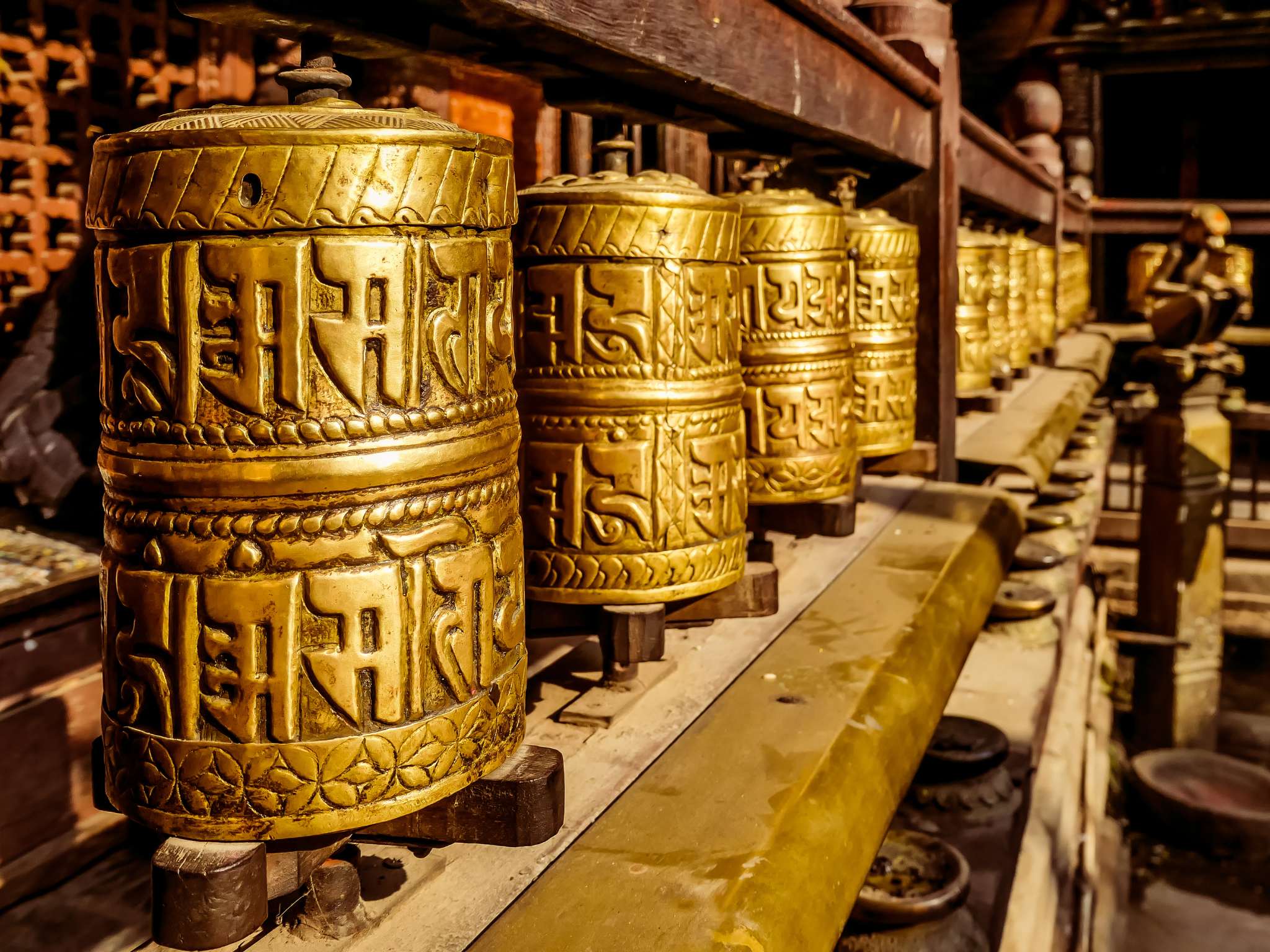
- Mani wheel: Also called a prayer wheel, this is a cylinder on a spindle that holds written mantras, most often Om mani padme hum, says Wikipedia. You’ll find rows of them around Boudhanath, where you turn them as you walk clockwise. Wikipedia reports a belief that spinning one earns much the same merit as reciting the prayers, though it marks that line as uncited.
- Lingam: An abstract symbol of the god Shiva, often a short pillar on a disc-shaped base called a yoni, says Wikipedia. Scholars disagree on its meaning. Wendy Doniger sees a phallic origin, Stella Kramrisch rejects the sexual reading, and Alex Wayman reports that Shaiva writers deny it. Wikipedia describes the main image at Pashupatinath as a one-metre stone lingam with four faces. It’s inside the area open only to Hindus.
Deities
These are the gods you’re most likely to hear named at the sites. Many are understood differently by different communities, and the valley’s Hindu and Buddhist traditions overlap.
- Shiva: A major Hindu god, often shown as an ascetic with a trident and snakes, and often called “the destroyer” in a trinity with Brahma and Vishnu, says the Rubin Museum. The Nepal Tourism Board calls Pashupatinath, his temple on the Bagmati, the most revered Hindu temple in Nepal.
- Vishnu: An important Hindu god, often called “the preserver”, who rides on Garuda and is said to have many avatars, including Krishna, says the Rubin Museum. The hilltop temple of Changu Narayan is dedicated to him.
- Garuda: A winged being. In Hinduism he’s Vishnu’s mount, while in Buddhism the name is used for eagle-like beings that protect the teachings, says the Rubin Museum. The Nepal Tourism Board dates the Garuda statue at Changu Narayan to the 5th century, and notes that it looks almost human.
- Bhairav: A fierce guardian worshipped by Hindus and Buddhists, and especially common in the valley, says the Rubin Museum. Hindus see him as a wrathful form of Shiva. Buddhists see him as an emanation of Manjushri, a bodhisattva. The Kal Bhairav statue stands in Kathmandu Durbar Square, and Wikipedia says it’s believed to be carved from one stone.
- Taleju: The royal goddess of the Malla kings, with temples in Kathmandu, Patan and Bhaktapur. Wikipedia says her exact identity remains uncertain. Hindu Newars have linked her with Durga and Kalika, and Buddhists with Tara. Bhaktapur.com says non-Hindus can’t enter the Taleju courtyard there.
- Kumari: A young Newar girl worshipped as a living goddess, by both Hindus and Buddhists. Sources name the goddess differently: Wikipedia says Taleju, and the Rubin Museum says Devi. Her role usually ends at her first period, says the Rubin Museum, and Wikipedia says an accidental wound can also end it. Several towns have their own Kumari. The best known lives at Kumari Ghar. Never photograph her.
People and history
These names come up on every plaque and tour. Dates vary between sources, so we show the range.
- Newar: The traditional people of the Kathmandu Valley, and the builders of much of what you’ll see. Wikipedia reports 1,341,363 Newars in the 2021 census, with both Hindu and Buddhist traditions. Their language is called Newar, Newari or Nepal Bhasa.
- Licchavi: The dynasty behind the valley’s first long run of dated records, starting in 464 AD. Wikipedia gives about 400 to 879 AD, while the Rubin Museum says mid-5th to mid-9th century. The Library of Congress study puts the last Licchavi inscription in 733. Sources also differ on origins. Wikipedia says they were a branch of the Licchavis of Vaishali, and the Library of Congress study suggests they may simply have adopted the famous name. Our history of Kathmandu Valley has the timeline.
- Malla: The kings who ruled the valley from about 1200 until 1769, and later split it into rival kingdoms at Kathmandu, Patan and Bhaktapur. That rivalry helped produce the art and palaces of the Durbar Squares, says the Rubin Museum. Wikipedia starts the dynasty in 1201, and the Rubin Museum in the early 13th century. Malla means “wrestler” in Sanskrit, says Wikipedia.
- Shah: The Gorkha dynasty of Prithvi Narayan Shah, who took Kathmandu in 1768 and Bhaktapur in 1769. The Nepal Tourism Board calls this the unification of Nepal. The Rubin Museum uses both words: one entry says he conquered the area, and another says the Shah kings unified it. The monarchy ended on 28 May 2008, says Wikipedia.
- Guthi: A Newar community trust or association that can pay for rituals, temples and festivals. Anthropologist David Gellner separates the institution from Guthi land tenure, and says many ritual tasks at the Machhendranath chariot festival fall to such groups. He dates guthis to at least Licchavi times, while Wikipedia says about the 5th century BC. OnlineKhabar sets out the critics’ view, that the land system has treated tenant farmers unfairly.
Festivals
These words matter most if your dates overlap with a festival. Many festival dates shift from year to year, so check each festival’s page.
- Jatra: A festival procession in which a deity’s image is carried through the streets, often on a chariot, with music and dance, says the Rubin Museum. Indra Jatra lasts eight days and centres on Kathmandu Durbar Square, according to Wikipedia. Bisket Jatra in Bhaktapur features a chariot of Bhairav pulled by rival parts of town.
- Tika: A mark on the forehead, used for worship, rites of passage or to welcome someone, says Wikipedia. It’s also the main blessing at Dashain, when elders give tika to younger relatives. Republica reports that some indigenous communities have been giving up tika at Dashain, and that Kirat people may use a white tika of rice and yoghurt, without red vermilion, though some also use red. If a family invites you to receive it, you can accept, but please don’t ask for it.