When is Shivaratri at Pashupatinath in 2027?
Maha Shivaratri falls on Saturday 6 March 2027, shown as Falgun 22, 2083 in the Nepali calendar. Every source we checked agrees on this date. It’s the 14th day of the waning moon in the lunar month of Falgun, so it moves against the Western calendar each year.
| Source | Date given for Shivaratri 2027 |
|---|---|
| Ministry of Home Affairs notice, via Pradhan and Associates | Saturday 6 March (Falgun 22) |
| Hamro Patro, 2083 BS list | Saturday 6 March (Falgun 22) |
| time.now | Saturday 6 March |
| CalendarLabs | Saturday 6 March |
| qppstudio | Saturday 6 March |
The Ministry of Home Affairs notice, as reproduced by Pradhan and Associates, gives the same date. Festivals follow the lunar calendar, so confirm the date close to your trip. There’s no 2026 date left, as Shivaratri 2026 was on 15 February.
What happens at Pashupatinath on Shivaratri?
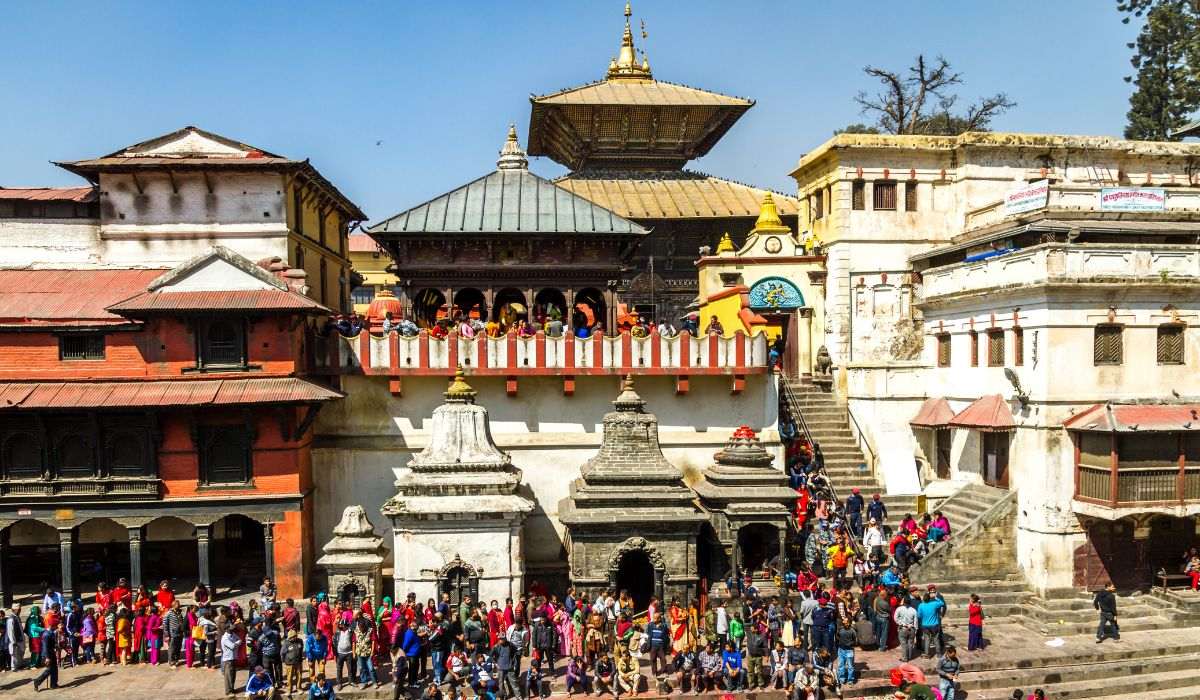
Devotees queue through the night and the day to worship at the temple, and thousands of sadhus (Hindu holy men and ascetics) gather in the grounds. PADT, the Pashupati Area Development Trust that runs the site, calls it the most sacred festival at Pashupatinath and describes an all-night worship.
Here’s what was reported in 2026, the most recent year we can document.
- The eve: PADT organised a procession across the Pashupati area with sadhus, saints and local devotees, says The Kathmandu Post.
- Before dawn: all four temple gates opened at 2 am. PTI quoted PADT’s executive director, Subhash Joshi, as saying devotees could see the Shiva Linga from all four sides.
- Through the day: devotees took ritual baths from early morning, and they lined up to worship.
- Services: Joshi listed free drinking water and food, sandalwood tika and emergency medical services.
- The sadhus: PADT arranged temporary accommodation, food and security for them, in designated areas.
Lights and marigold garlands go up along the routes to the temple beforehand, according to Spotlight Nepal. PADT’s site also mentions a riverside fair for sadhus, yogis and pilgrims, and a special evening aarti (lamp ceremony) at the Bagmati ghat.
How big are the crowds, and how many come from India?
Crowds run from hundreds of thousands to a reported million or more, though the figures are mostly forecasts and we found no final count. The sources don’t agree, so here’s who says what.
| Source | Figure | About |
|---|---|---|
| PADT, via The Kathmandu Post, February 2026 | At least 800,000 devotees | 2026 forecast |
| PTI, February 2026 | About 800,000 pilgrims, including 30 per cent Indians | 2026 forecast |
| The Kathmandu Post, 15 February 2026 | More than one million | 2025 |
| Spotlight Nepal, February 2026 | Over a million from home and abroad | General claim |
| PADT website | Hundreds of thousands of pilgrims and sadhus from India and Nepal | General |
If PTI’s figure held, that would be about 240,000 Indian pilgrims, by our calculation. PTI said the temple was decorated to welcome Hindu devotees from Nepal and abroad, mainly from India. PADT expected about 4,000 sadhus, some from India and other countries.
We found no count of non-Hindu or foreign tourist visitors on the day. If you’ve seen a number for them, treat it with care.
Can non-Hindus attend?
Non-Hindus can’t enter the main temple on Shivaratri or on any other day. On normal days, PADT says everyone may visit the ghats, gardens and surrounding shrines, and watch aarti from the eastern bank of the Bagmati. Read the full Pashupatinath rules for non-Hindu visitors.
We found no 2026 or 2027 notice saying how these rules change on the festival day. Expect to be kept out of the worship queues, and don’t count on your usual route or viewpoint. Stewards and police decide on the spot, so follow what they say.
How should visitors behave?
Remember that you’re a guest at a major act of worship. Keep out of the queues, since people may have waited for hours, and don’t cut across them to reach a viewpoint.
- Dress modestly. PADT says shorts and sleeveless tops aren’t permitted on temple grounds.
- Don’t photograph worship. PADT bans photography inside the main sanctum and during religious ceremonies. Ask before you photograph any sadhu, and accept a no.
- Respect the ghats. PADT lists its ghat services as running 24 hours a day. Read our guide to the Pashupatinath cremation ghats, and don’t take photographs of funerals.
- Leave leather outside the main complex, as the Nepal Tourism Board asks.
- Keep your valuables close, and agree a meeting point in case you’re separated.
How does Shivaratri affect traffic and sightseeing?
Shivaratri affects the whole eastern side of the city, including the road from the airport to the temple. The Kathmandu Post described the queue plan for 2026, and it gives a good idea of how far the crowds reach.
| Queue line in 2026 | Route |
|---|---|
| South gate, line 1 | Mitrapark to Gaurighat |
| South gate, line 2 | Battisputali and Gaushala, Tribhuvan International Airport and Tilganga, and Pingalasthan, via Panchdeval |
| West side | From the footwear area via the Banikali slope, with an extra line towards Tilganga Rammandir |
PADT arranged parking at Sifal, Tilganga, beyond Guheshwari, the PADT office and Banakali. It also set up pedestrian routes at major entry points and kept lanes free for emergency vehicles. Around 8,000 security personnel were deployed in 2026, including Nepal Army members, partly because of an election that year.
Here’s what that suggests for your plans. These are our own suggestions and not official advice.
- Flights: allow extra time for the airport on 5 and 6 March, as one queue line runs from the airport road.
- Sightseeing: the other sites, such as Patan Durbar Square, are in a different part of the valley. They make a sensible plan for the day if you don’t want the crowds.
- Other events: Hamro Patro also lists Nepali Army Day on this date.
- Boudhanath: it’s close to Pashupatinath, so allow more time for the road.
Should you plan a visit around Shivaratri?
Go if you want to see the scale of the pilgrimage and you’re happy with crowds, waiting and limited access. Choose another day if you want to walk the grounds slowly. PADT lists the site as open daily, and the Pashupatinath and Boudhanath tour goes there at dusk.
On a private tour, site swaps can be arranged. Tell us your date when you ask about a tour, and check that date against the Nepali calendar again a week or two before you travel.